Get Your Free Quote…!

Bulk material handling systems play a critical role in industrial operations where powders, granules, pellets, and other solid materials must be transported, stored, or processed efficiently. Industries that work with these materials depend on specialized equipment to regulate material flow safely and consistently. One of the most widely used components in such systems is the slide gate.
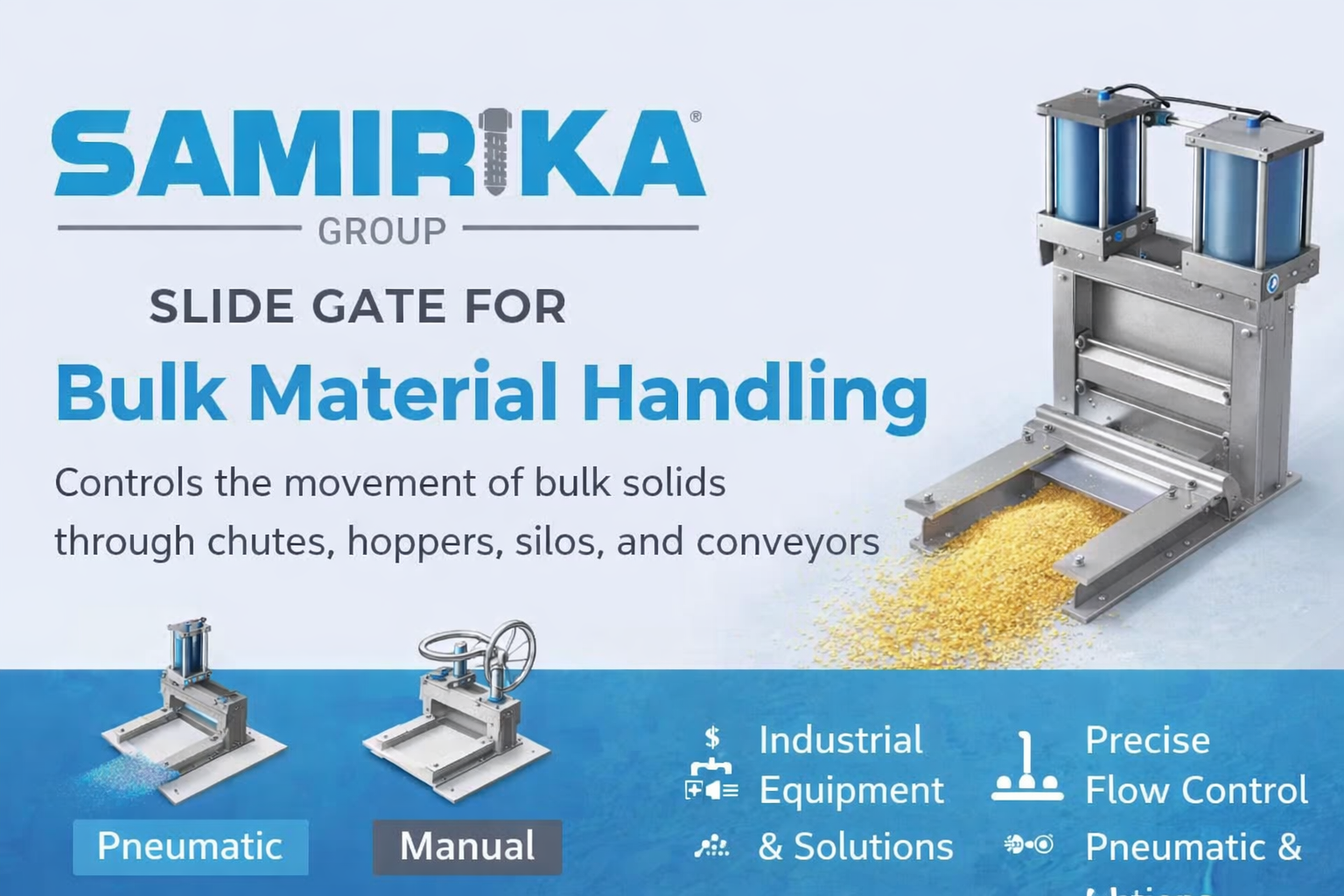
A slide gate for bulk material handling is designed to control the movement of bulk solids through chutes, hoppers, silos, conveyors, and other material transfer pathways. By allowing operators or automated systems to open, close, or regulate the flow of materials, slide gates help maintain stable production conditions and prevent uncontrolled discharge.
In industrial environments where bulk materials are continuously transferred between storage and processing units, reliable flow control becomes essential. Slide gates provide a dependable mechanical solution that supports operational safety, improves process efficiency, and ensures materials move through the system in a controlled and predictable manner.
Material handling systems often consist of interconnected components such as conveyors, storage bins, hoppers, feeders, and discharge systems. Within these setups, controlling the movement of bulk materials between different stages is essential to avoid blockages, overflow, or uneven material distribution.
A slide gate functions as a flow isolation and control device installed at strategic locations within the material handling system. The gate typically includes a sliding blade or plate that moves across an opening. When the blade is open, material flows through the opening; when it is closed, the flow is stopped.
Because bulk materials behave differently depending on factors such as particle size, density, moisture content, and flow characteristics, slide gates are engineered to operate reliably under a variety of conditions. Their simple yet effective design makes them suitable for handling a wide range of industrial materials.
Slide gates used in industrial material handling systems generally fall into two main categories based on their method of operation. The selection between these types depends on operational requirements, the level of automation, and overall process complexity.
A pneumatic slide gate operates using compressed air that drives a pneumatic actuator or cylinder. This actuator moves the gate blade to automatically open or close the flow path. Pneumatic slide gates are commonly used in automated industrial environments where material flow must be controlled remotely or integrated with process control systems.
These gates are widely installed in facilities where continuous production processes require fast and precise control over material movement. Pneumatic operation enables the gate to respond quickly to system signals, making it suitable for automated batching, dosing, and discharge operations.
A manual slide gate is operated directly by an operator who moves the gate blade through a handle, lever, or sliding mechanism. These gates are typically used in applications where automation is not necessary and manual control provides adequate functionality.
Manual slide gates are often found in smaller-scale operations, maintenance access points, or locations where the gate does not require frequent adjustments. Their straightforward design makes them easy to install, operate, and maintain.
The operation of a slide gate is based on a straightforward mechanical principle. The system generally includes a gate frame, a sliding blade or plate, and a guiding mechanism that allows the blade to move smoothly across the opening.
When the gate blade moves away from the opening, the material stored above the gate is allowed to pass through the discharge point. When the blade moves across the opening, the flow is restricted or completely blocked. The design typically ensures a tight seal when the gate is closed, helping prevent unwanted material leakage.
Depending on the system configuration, slide gates may be installed at the bottom of silos, beneath hoppers, along conveyor discharge points, or within pneumatic conveying systems. The placement of the gate determines how material flow is controlled within the overall processing system.
Slide gates are engineered to perform reliably in demanding industrial environments where continuous material movement is required. Their design focuses on durability, operational stability, and compatibility with different types of bulk materials.
Important features commonly associated with slide gate systems include:
These features make slide gates a practical and dependable solution for industries that rely on efficient bulk material transfer systems.
Slide gates are widely used across industries that handle large quantities of bulk materials. Their ability to regulate material flow makes them an essential component in many industrial processing environments.
Common applications include:
Because bulk materials vary significantly in composition and flow behavior, slide gates are designed to perform reliably under different industrial operating conditions.
Bulk material handling systems are designed to move materials efficiently while maintaining consistent production conditions. Without effective flow control mechanisms, these systems may experience problems such as overfeeding, uneven distribution, equipment overload, or material loss.
Slide gates help prevent these issues by providing a controlled discharge or isolation point within the system. By opening or closing the gate at specific intervals, operators can regulate how materials move through the processing line.
In automated systems, pneumatic slide gates can respond to sensors and control signals, ensuring materials are released only when required. This level of control supports accurate batching, improved process stability, and reduced operational risks.
Selecting the appropriate slide gate for bulk material handling systems requires careful evaluation of several operational factors. The characteristics of the material being handled often influence the design and specifications of the gate.
Some important factors to consider include:
By considering these factors, industries can choose slide gate systems that align effectively with their operational requirements.
In many industrial operations, efficiency depends on the ability to move materials smoothly through multiple stages of processing. Slide gates contribute to this efficiency by enabling controlled transfer of materials between different parts of the system.
Well-designed slide gates help prevent blockages, reduce material spillage, and ensure that materials reach the next stage of production at the correct rate. This improves overall workflow stability and minimizes downtime caused by uncontrolled material flow.
When integrated into automated systems, pneumatic slide gates further enhance efficiency by responding instantly to process signals. This enables industries to maintain consistent production cycles and improve overall operational reliability.
Although slide gates are relatively simple mechanical devices, proper maintenance is essential to ensure long-term performance. Industrial environments often expose equipment to dust, abrasive materials, and continuous operational loads.
Routine inspection and maintenance practices may include checking the sliding blade for wear, ensuring proper alignment, and confirming that sealing surfaces remain intact. In pneumatic systems, maintaining the actuator and air supply components is also important.
Regular maintenance helps prevent unexpected failures and ensures that the slide gate continues to operate smoothly within the bulk material handling system.
Bulk material handling systems require reliable components that regulate the movement of materials across different stages of industrial processing. A slide gate for bulk material handling provides an effective solution for controlling the discharge of powders, granules, and bulk solids within these systems.
By enabling controlled flow management, slide gates support safe operations, stable production processes, and improved system efficiency. Whether used in manual or pneumatic configurations, slide gates remain an essential component of modern industrial material handling infrastructure.
A slide gate for bulk material handling is used to regulate the flow of powders, granules, or bulk solids in industrial systems. It allows operators to open, close, or restrict material movement between storage and processing equipment.
A pneumatic slide gate uses compressed air to automatically open or close the gate through an actuator, while a manual slide gate is operated physically by an operator using a handle or sliding mechanism.
Slide gates are commonly installed beneath silos, storage bins, and hoppers. They may also be positioned along conveyors, pneumatic conveying systems, or discharge chutes to control bulk material flow.
Slide gates can handle a wide range of materials including powders, grains, pellets, aggregates, chemicals, and mineral materials used in industrial manufacturing and processing systems.
Flow control ensures that materials move through processing systems in a stable and predictable manner. Without proper control, operations may experience issues such as blockages, uneven feeding, or material wastage.
Yes, pneumatic slide gates are commonly integrated into automated industrial systems. They can respond to control signals and sensors to regulate material flow during automated production processes.
Phone
Filter Using Product Tags